High strength and high conductivity heat-resistant copper alloy
HRSC
C18620(Pipe)
C18625(Strip・Plate、Bar、Wire、Forgings)
High strength and high conductivity heat-resistant copper alloy
C18620(Pipe)
C18625(Strip・Plate、Bar、Wire、Forgings)
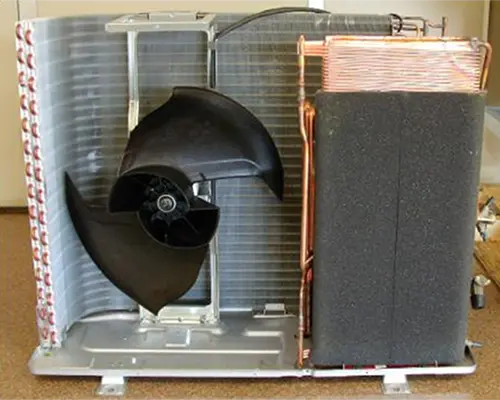
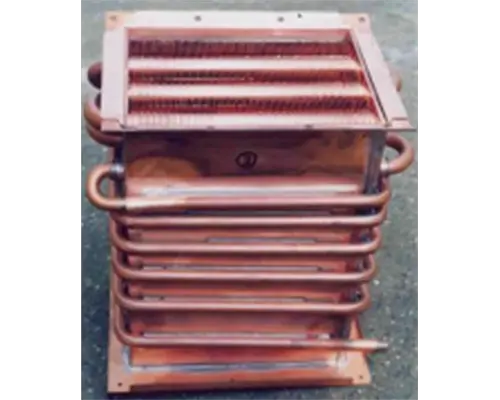
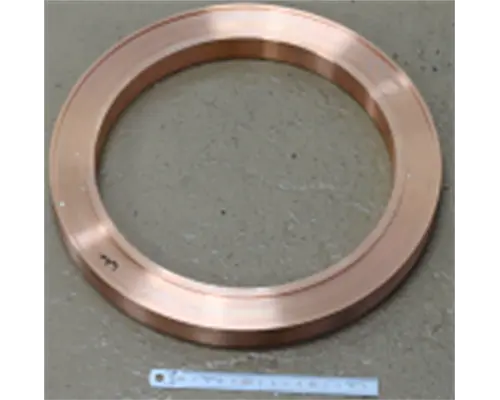
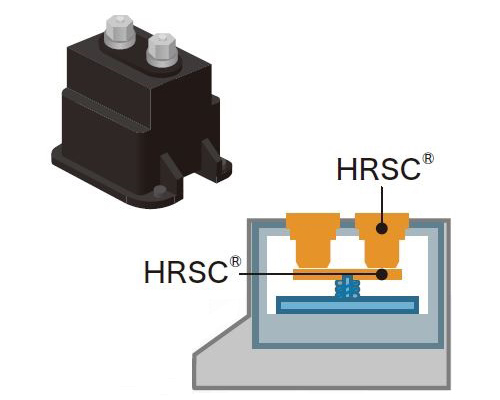
Heat sink, heat spreader/Heat exchanger, EcoCute high pressure piping/Power relay





Production and sales of bars will be discontinued in March 2028.
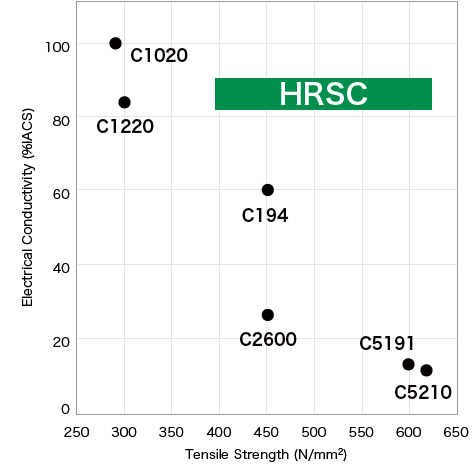
HRSC has high thermal conductivity and high electrical conductivity.
And it has an excellent balance of strength and workability.
HRSC maintains initial strength inspite of heat -treatment at 800℃×10min due to the grain growth is
suppressed.
HRSC is able to be provided at various shapes (such as plate,strip,rod/bar,pipe,wire and hot
forged).
HRSC is a heat-resistance copper alloy. And it has high electric conductivity (equal to Phosphorus deoxidized copper‐C1220) and strength (par with brass‐C2600 and Phosphor bronze‐C5191) .
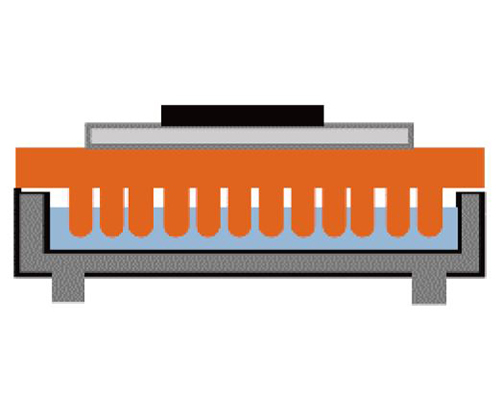
(Weight %)
| Cu | Co | P | Sn | Ni |
|---|---|---|---|---|
| Rem. | 0.27 | 0.08 | 0.04 | 0.04 |
(Weight %)
| Property | Representative Value |
|---|---|
| Specific Gravity (293K) | 8.9 |
| Coefficient of Linear expansion( ×10-6/K:293~573K) | 17.1 |
| Thermal Conductivity(W/(m・K):293K) | 330 |
| Electrical Conductivity(%IACS:293K) | 85 |
| Modulus of Elasticity(kN/mm² : 293K) | 125 |
| Poisson Ratio(293K) | 0.33 |
| Shape | Strip※ | Rod/Bar | Forging |
|---|---|---|---|
| Size(mm) | 0.65 | Φ10 | - |
| Temper | H | H | As aged |
| Tensile Strength (N/mm²) |
525 | 540 | 380 |
| 0.2% Yield Strength (N/mm²) |
510 | 520 | 255 |
| Elongation (%) |
5 | 15 | 40 |
| Vickers Hardness (HV) |
(160)* | 165 | 115 |
| Electrical Conductivity (%IACS) |
85 | 85 | 85 |
Even after brazing heat treatment (800 °C x 10 minutes), there is no coarsening of the metal structure and it has thermal stability compared with C1220.
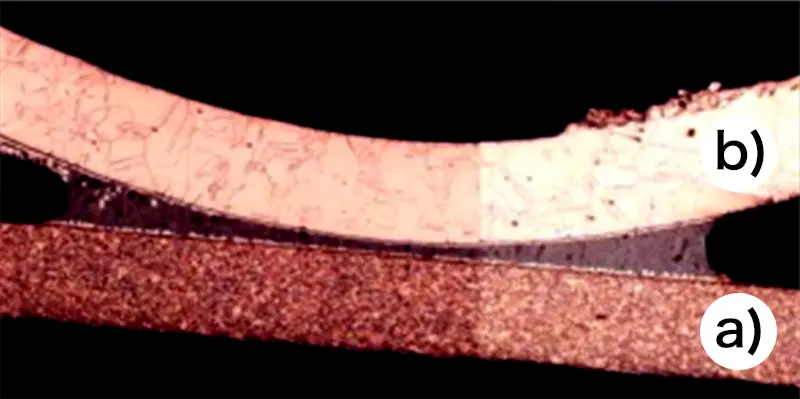
Heat treatment condition: 800 °C × 10 min (equivalent condition for brazing in
furnace)
a) HRSC (G.S. 10 µm) 0.2% proof stress of 110 N/mm²
b) C1220 (G.S. 100 µm) 0.2% proof stress of 22 N/mm²
Heat resistance:cross-sectional structure and strength after brazing heat treatment
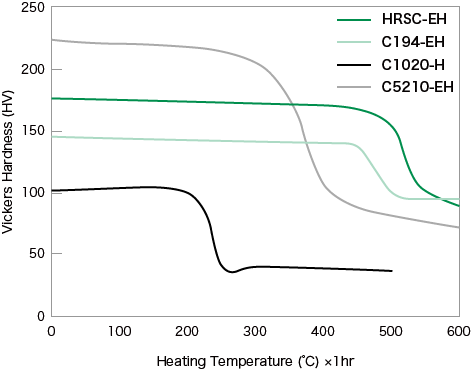
Heat resistance: isochronal annealing curve
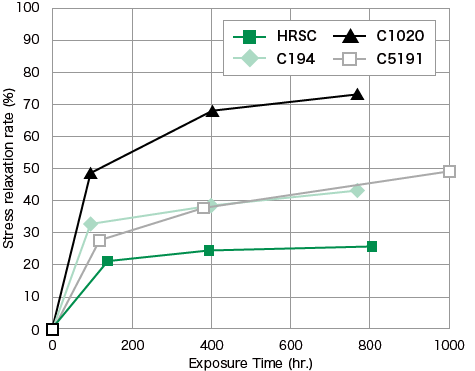
Test method: JCBA-T309: 2004
Exposure temperature:150℃
Bending stress: 0.2% yield
strength 80%
Evaluation: The mean value of TD and LD
It has good bending workability and it can cope with various processing.
| Temper | Sampling Direction | Bending Inside Radius (mm) R | Evaluation | |||||||||
|---|---|---|---|---|---|---|---|---|---|---|---|---|
| 0.0 | 0.1 | 0.15 | 0.2 | 0.3 | 0.4 | 0.6 | 0.8 | 1.0 | 2.0 | R/t | ||
| H | G.W. | ▲ | ▲ | △ | △ | △ | △ | ○ | ○ | ◎ | ◎ | 0.2 |
| B.W. | ▲ | ▲ | ▲ | ▲ | ▲ | △ | △ | △ | ○ | ◎ | 0.6 | |
| EH | G.W. | ▲ | ▲ | ▲ | ▲ | △ | △ | △ | ○ | ○ | ◎ | 0.5 |
| B.W. | ▲ | ▲ | ▲ | ▲ | ▲ | ▲ | △ | △ | △ | ○ | 0.9 | |
Bending test 180°(B.W.) R/t=0
Temper: H, Thickness0.64mm
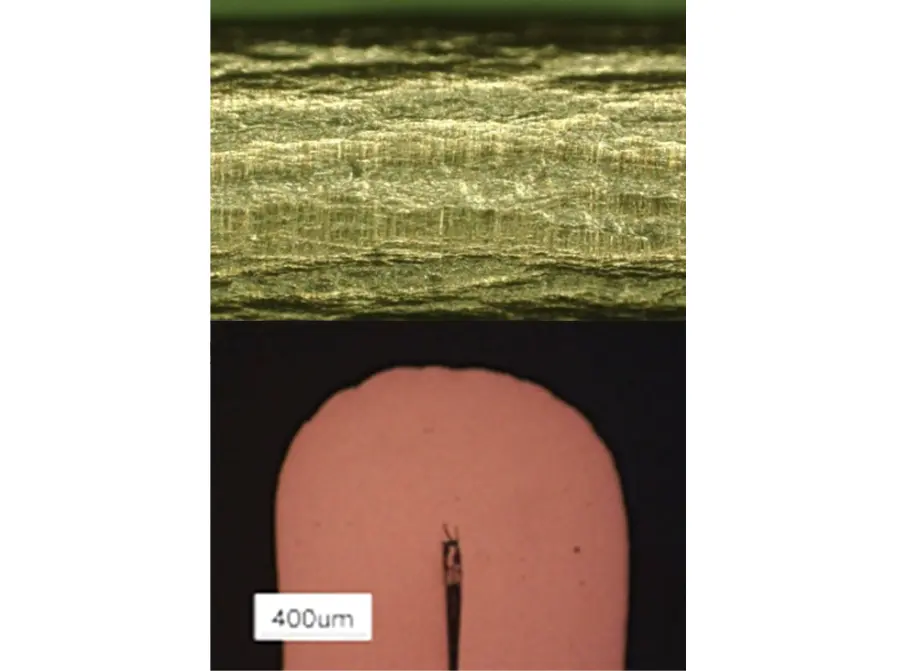
Strip: 180°adhesion bending
Rod/Bar Temper: 0, φ25mm
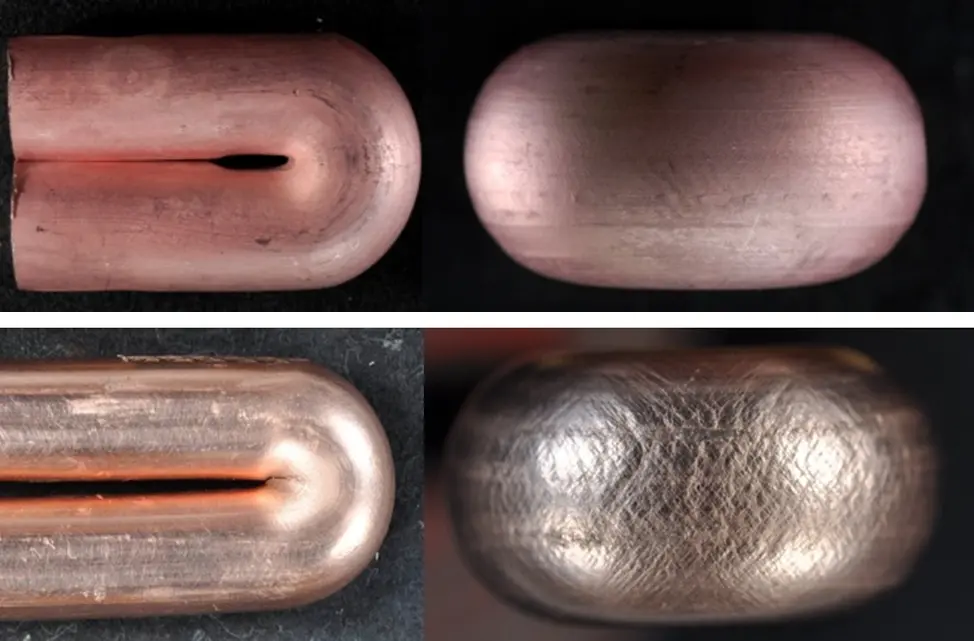
Bar: 180°bending appearance
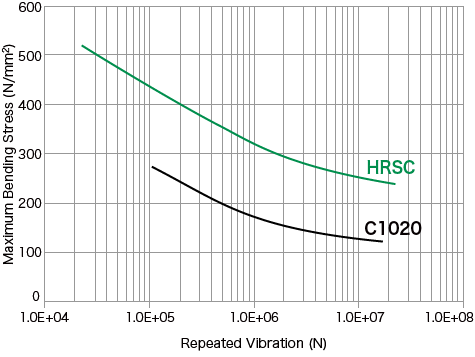
It has good fatigue property.